Showing posts with label Ichiro. Show all posts

Wednesday, September 17, 2014

More on Ichiro

After my post about Ichiro's Platinum Season, I had a conversation with my friend (okay let's be honest, this is how all these blogs start. From now on, he'll be known as Jon) about Ichiro's career and comparing him to other folks in the Majors and the work they've done. I mentioned in my post that Ichiro has over 2,800 hits in America, and over 4,000 total in professional baseball - and here is where Jon's wisdom set me off again: could Ichiro have surpassed Pete Rose's all-time hits record?

Honestly, I think a lot of it depends. Let's see if I can give you some evidence to make you decide for yourself.

Ichiro's Favor
1. Speed. Pete Rose is known as Charlie Hustle, but Ichiro's left-handedness (3 or 4 fewer feet to run to first), swing style,
Ichiro is already a few steps to first while making contact with the ball. 
and pure speed aided him in getting infield hits. Pete Rose didn't have the speed to beat out a chopper to short, but he did have the hustle to stretch a single into a double. At that point, a hit is already a hit, it's just for slugging percentage. But on any random groundball to the left side, Ichiro has a much better chance at beating it out than Pete Rose because he's faster and has a shorter distance to run. This also made him a stealing threat (led the league in 2001 and is the active leader in steals) while Pete Rose only has 198. 


2. BABIP. BABIP, or batting average on balls in play, is a stat used by sabermetricians to determine a players' effectiveness when they don't strike out. It's useful for guys like Ryan Howard or Adam Dunn, because it seems like they either hit it 450 feet or strike out. BABIP is used to show their average on when they make solid contact. As of 2009, Ichiro's BABIP was insanely higher than the league average on ground balls (.242) and bunts (.441). Ichiro's averages: .305 and .663, respectively. This means out of 1,000 ground balls, Ichiro reaches base safely 63 more times than average Joe. On 1,000 bunts, he reaches 222 more times. On a larger scale, Ichiro's career BABIP is .344 compared to Pete Rose's .319. Ichiro has 453 career infield hits, just around 16% of his hit total.  

3. Age. Ichiro entered the league at age 27, basically his athletic prime. He's still in great shape, but the hits aren't coming in bunches like they used to, and that's to be expected when you hit the dinosaurish landmark 40th birthday in the sporting world. Ichiro has played 2,184 career games in the MLB and has amassed 2,834 hits. In 2,184 games, Pete Rose collected 2,773 hits - 61 fewer hits is about a quarter of a season for these guys. Bear with me, this is where it gets confusing. Through 2,184 games (odd sample, I know, but it's Ichiro's career), Ichiro has 1.297 hits per game compared to Rose's 1.269 hits per game. If you were to adjust Ichiro's debut to match Rose's at age 22 and match their games played, Ichiro would have approximately 100 more hits. Remember, this is strictly mathematical. I took Rose's 3,562 games x 1.269 hits per game to equal 4,520 (he finished with 4,256) versus if Ichiro payed 3,562 games x 1.297 hits per game to equal 4,619 hits. Factor in depreciation, age, pitcher recognition, etc., like with Rose and you're right around 4,300 hits. 

Rose's Favor
1. Speed. I know this was a point for Ichiro, but players lose speed over the years. Like I said before, 16% of his hits in his career are infield hits. If he were to rely on that his whole career, teams would guard against it (reverse shift) or throw pitches up in the zone to make him fly out since he has no home run power. Not to mention he would lose a step or two as he got older and be easier to throw out. While Rose's speed never got him more infield hits, his style stands the test of time while Ichiro's wouldn't.

2. Pitching Quality. Pete Rose was a pure hitter. He didn't care who he faced or what he was throwing, he hit it - he's a .306 career hitter against Hall of Fame pitchers (he faced 22 in his career), including 60-177 off Don Sutton, 42-147 off Juan Marichal, and 35-114 off of Bob Gibson. Now, compare this to Ichiro, who was a teammate of the best pitcher of our generation (Randy Johnson), but is 8-18 against him. Here are some career lows for Ichiro against the studs:

  • .262 against Roy Halladay
  • .217 against Pedro Martinez
  • .200 against Roger Clemens
  • .125 against David Price
  • .077 against Curt Schilling
That said, Ichiro is .500 against Kershaw and .333 against CC Sabathia, but I think Rose has a serious advantage in this category. See for yourself: Rose vs. pitchers or Ichiro vs. pitchers. 

3. Teammate Protection. Pete Rose played for the Big Red Machine in the height of the Reds' dominance of the NL. In fact, the Reds were the first team ever to have 5 different All-Star Game MVPs (Perez, Griffey, Foster, Morgan, Concepcion) on the same roster, meaning these guys can seriously hit. Pete Rose was the Reds leadoff hitter for all that time, but do you really want to pitch against Joe Morgan (HOF, 2 MVPs), Johnny Bench (HOF, one of the greatest catchers ever), and Tony Perez all in the same inning? No! You're going to go after Rose and get him out as early as possible. That means he'll see plenty of strikes and pitches to hit. Bad news for pitchers: it's Pete Rose. He won't miss. Compare this to Ichiro, who, other than 2001, has been on mostly losing teams. After Ichiro, you have Mike Cameron (.249 career), John Olerud (.295 but no power), and Edgar Martinez, who is a legitimate power threat but grounds into a lot of double plays. I think if I were a pitcher I'd take my chances with this 2-3-4 than Ichiro. Pitch around him. 

So there are my reasons for both sides. Between you and me, though, if Ichiro played in America since his career began at age 20, he would have passed Pete Rose by now. But we can only make guesses at this point. Let's just leave it at this: they're both amazing.

And so are you. Thanks for reading. 

Tuesday, September 16, 2014

The Platinum Season

So my buddy and I were musing through Baseball Reference the other day, as we normally do after I'm done working and he's done with classes. I don't quite remember how it came up but we were discussing the NL Rookie of the Year race (my bet is Jacob deGrom) and our conversation slowly drifted towards prominent rookies and we came across Ichiro in 2001.

What Ichiro did that year was something that no one else in the history of baseball has ever done, something I like to call The Platinum Season, when he was selected to start the All-Star Game (not just start, but lead off and play centerfield as well for the home AL), won a Gold Glove in one of three outfield spots (other winners were Mike Cameron and Torii Hunter), a Silver Slugger in one of three outfield spots (along with Manny Ramirez and Juan Gonzalez) and a batting title. Those awards are B-List awards if you ask me; consolation prizes for players who don't bring home serious bacon like the MVP and Rookie of the Year.

In 2001, Ichiro brought the whole pig home with the American League Most Valuable Player and Rookie of the Year. 

Ichiro is already the greatest Japanese player ever play for a Major League team. With 9 total Gold Gloves, an MLB record 10-straight seasons with 200+ hits (5 straight seasons leading the MLB in hits), 2 batting titles, almost 3,000 hits (over 4,000 total in professional baseball including his time in Japan), and 484 steals entering tonight (most among active players), he is a lock for the Hall of Fame, making him the first Japanese born player to be inducted. Here's a fun piece from CBS Sports about Ichiro learning Spanish to talk trash to other Hispanic players - as if he wasn't good enough already. 

But the Platinum Season. It isn't impossible, as our slender subject of tonight's conversation has proved, but it's close to it. Not only is it your first full season in the bigs, but you have to be the best at everything - fielding, hitting, and enough of an asset to a winning team to be considered the Most Valuable. The fans have to love you to vote you to start, and the press has to love you to vote you in. But the advancement of the game and its awards have handcuffed some of the greats. For example:


  • All-Star selections: The first ASG wasn't until 1933. Babe Ruth, the greatest hitter of all time, only was selected twice. But that wasn't a direct indication of skill: it was timing.  

  • Rookie of the Year Award: not introduced until 1947 with Jackie Robinson its inaugural winner 

  • Gold Gloves: Not introduced until 1957. Even then, it was consolidated between both the AL and NL. 

  • Silver Slugger: Not introduced until 1980!


  • There is some consternation about when the MVP was first awarded. According to MLB.com, the first MVP award was granted in 1931, but on Baseball Reference, there are smatterings of MVP awards between 1914 and 1931, so they must not have been officially awarded and recognized until 1931. So when I said that Ichiro is the only person to have ever achieved the Platinum Season, that's statistically true, but maybe not historically true, simply because some of the awards weren't created yet! 

    Here is what I'm going to do: I'm going to try my best to speculate who would have won those awards in the past to compare them to Ichiro's Platinum Season. For the sake of argument, we'll stick with the MVPs officially recognized by MLB.com beginning in 1931. For the most part, this makes our job easy, because the MVP winners from 1931-1947 weren't rookies, so they are all, unfortunately, eliminated from the Platinum Season. Now, with the list of Rookies of the Year, 20 of them have gone on to win an MVP award (since the inception of the award, of course). Only two have won it in the same year: Ichiro (2001) and Fred Lynn (1975). 


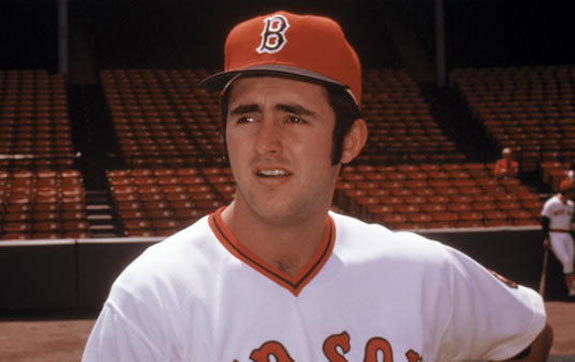
    Fred Lynn is kind of an underwhelming case in baseball history. He's hit the only grand slam in All-Star Game history, one of two to ever win an MVP and ROY, and was a doubles machine until he left Boston. In his first three years with the Angels, Lynn was selected to All-Star teams but only hit .271 with 66 doubles when he hit 47 doubles his rookie year. Production fell right off the table and I think a Hall of Fame potential player disappeared. Anyway, Lynn is Ichiro's competition for the Platinum Season. 

    MVP? .331/.401/.566, 21 home runs, 105 RBIs, 103 runs, 47 doubles - Check.
    ROY? Beat teammate Jim Rice by 22 points in average, 51 points in OBP - Check.
    Gold Glove? Check.
    All-Star? Check.
    Silver Slugger? Funny you should ask. Lynn was a center fielder in 1975, his best year. The way Silver Sluggers are awarded make this a bit tricky. Since there are three outfield positions to award, the MLB doesn't pick a left fielder, right fielder, and center fielder, they just pick three outfielders who slug (hence the name). So let's see if Lynn would have held up in 1975 against other AL outfielders.

    Reggie Jackson would have been a shoo-in. Mr. October (also the strikeout king) had 36 homers, 104 RBIs, and a .511 slugging percentage. Lynn has him beat in RBIs and SLG% but it's Reggie Jackson compared to a rookie. Jackson has one of the three.

    Bobby Bonds had a statistically similar season, collecting 32 home runs, 85 RBIs and posting a .512 slugging percentage. Again, not as good as Lynn, but the increased number of home runs and slugging percentage give him the edge for the second outfield spot.

    The last competitor/candidate would be Don Baylor, who hit 25 home runs, 76 RBIs, and slugged .489. All good, but not as good as Lynn, who led all outfielders in slugging and RBIs. If I were voting, I'd give Lynn the Silver Slugger, giving him another Platinum Season. 

    Ichiro did it in 2001, and it was amazing. He blew Americans out of the water with how smoothly he transitioned from Japan to the MLB. At age 27, he led the Mariners to 114 wins in the regular season and the ALCS against Jeter's mighty Yankees. Remember how much buzz there was about Tanaka coming to the MLB this offseason? I wish I was old enough to remember how much hype their was about Ichiro and how he blew it all away.

    But Fred Lynn did it as a 23 year old straight out of USC. He played briefly at the professional level in 1974 but after a year at AA in 1973, and split time in 1974, I think his Platinum Season in 1975 was a little better. 4 years younger, almost no professional baseball. But the competition wasn't quite as good, either. 

    You be the judge. Thanks for reading.