- That's the first and only time that both Cy Young winners were named MVPs as well. There have been 10 pitchers to win both awards in the same season, but never in both leagues.
- Since the award has been given to both leagues in 1967, Bob Gibson is the only National League pitcher to win both awards (Sandy Koufax and Don Newcombe, both Dodgers, won CYA and MVP but before there were 2 CYA).
- Bob Gibson's 1.12 ERA is the 4th lowest single season ERA ever. The next closest ERA for a pitcher after 1920 is Greg Maddux's 1.559 ERA in 1994.
- McLain is the one of 2 pitchers with 31 wins in the Live Ball Era and the only one with 30+ after World War II (Lefty Grove won 31 games in 1931).
- The 1968 World Series featured 3 complete games each from Mickey Lolich and Bob Gibson - the only time that has ever happened.
So 1968 was clearly the Year of the Pitcher. But what's the runner-up?
Answer: 1995. Winners: Greg Maddux (19-2, 1.63) and Randy Johnson (18-2, 2.48).
After the grudge match of the 1994 strike that resulted of the fans being stripped of a World Series, baseball came back with a bang. In 1995, the Indians' Albert Belle became the only person in baseball history to have a 50 home run-50 double season, Atlanta continued their tirade on the NL East, finishing 21 games ahead of the 2nd place Mets and Phillies, and future Hall of Famer Barry Larkin won his only MVP award, hitting .319. With an abbreviated 1994 season, fans simply missed the game. Any action would have been nice to see, but a pair of 2-loss seasons from the greatest pitchers of the last 30 years blew us all away. Welcome back, baseball.
It wasn't quite the level of 1968 where Gibson had an absolutely absurd ERA and McLain had an absolutely absurd win total, but I think that these seasons are just as impressive. Think about baseball in the 60s, there weren't a whole lot of huge sluggers around; Aaron, Mays, Schmidt, an aging Mantle, and Killebrew were really the brunt of the power. Compared to 90s, with McGwire, Canseco, Sosa, Bonds, Griffey, Thome, A-Rod, Albert Belle (in 1995 at least), there were sluggers popping up left and right. Sure a lot of them were steroid users, but doesn't that make Maddux's 8 home runs allowed over 209 innings all the more impressive? I think so (of course I do, I'm the one writing). I'll share some quick highlights about both of their seasons and why 1995 was the Year of the Cy Young Pitcher Part II.
Maddux
Mad Dog was always praised for his durability. Among all his league-leading stats, he led the league in starts the most, with 6 times (including when he was 39). In fact, except for his rookie year, Maddux made at least 25 starts every single year he ever pitched. But in 1995, he only started 28 times, and he made the most of those starts.
After the grudge match of the 1994 strike that resulted of the fans being stripped of a World Series, baseball came back with a bang. In 1995, the Indians' Albert Belle became the only person in baseball history to have a 50 home run-50 double season, Atlanta continued their tirade on the NL East, finishing 21 games ahead of the 2nd place Mets and Phillies, and future Hall of Famer Barry Larkin won his only MVP award, hitting .319. With an abbreviated 1994 season, fans simply missed the game. Any action would have been nice to see, but a pair of 2-loss seasons from the greatest pitchers of the last 30 years blew us all away. Welcome back, baseball.
It wasn't quite the level of 1968 where Gibson had an absolutely absurd ERA and McLain had an absolutely absurd win total, but I think that these seasons are just as impressive. Think about baseball in the 60s, there weren't a whole lot of huge sluggers around; Aaron, Mays, Schmidt, an aging Mantle, and Killebrew were really the brunt of the power. Compared to 90s, with McGwire, Canseco, Sosa, Bonds, Griffey, Thome, A-Rod, Albert Belle (in 1995 at least), there were sluggers popping up left and right. Sure a lot of them were steroid users, but doesn't that make Maddux's 8 home runs allowed over 209 innings all the more impressive? I think so (of course I do, I'm the one writing). I'll share some quick highlights about both of their seasons and why 1995 was the Year of the Cy Young Pitcher Part II.
Maddux
Mad Dog was always praised for his durability. Among all his league-leading stats, he led the league in starts the most, with 6 times (including when he was 39). In fact, except for his rookie year, Maddux made at least 25 starts every single year he ever pitched. But in 1995, he only started 28 times, and he made the most of those starts.
- On June 15th against Montreal, Maddux only needed 87 pitches to shut out the Expos.
- From May 12th to July 29th he didn't hit a batter.
- From August 26th to the end of the regular season he didn't allow a home run.
- He was 13-0 on the road with a 1.12 ERA in 15 starts.
- He had a .21 ERA when the Braves scored between 0-2 runs (1 run in 5 games) with a 17:1 strikeout to walk ratio.
- He allowed only 8 2nd inning hits all year (random, I know).
- He was 7-0 against the NL East with a 1.62 ERA.
Unbelievable.
Johnson
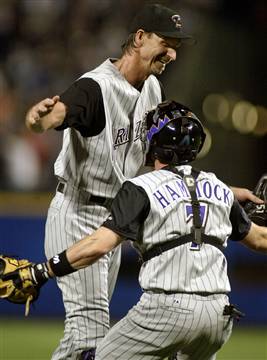
Johnson won his first of 5 Cy Youngs in 1995, going 19-2 with a 2.48 ERA (terrible compared to Maddux, but still led the AL). He also struck out 294 batters, most in the Majors by 58 K's (almost 6 games worth). It went Johnson 294, Nomo 236, Stottlemyre 205, and that was it for people over 200. He blew away both batters and other pitchers with how dominating his 6' 10" frame was coming down on them. Let's delve.
Johnson
Johnson won his first of 5 Cy Youngs in 1995, going 19-2 with a 2.48 ERA (terrible compared to Maddux, but still led the AL). He also struck out 294 batters, most in the Majors by 58 K's (almost 6 games worth). It went Johnson 294, Nomo 236, Stottlemyre 205, and that was it for people over 200. He blew away both batters and other pitchers with how dominating his 6' 10" frame was coming down on them. Let's delve.
- In 1995, Johnson had 16 10+ strikeout games.
- He averaged 119.8 pitches per start (including a rain delay game in which he threw 37 pitches), including 141 in back-to-back starts in June and 160 in a complete game against Cleveland.
- He faced 866 batters, not even cracking the top 10. This means he struck out 30.5% of the batters he faced, compared to Maddux's 23.5%.
- Tale of two pitchers: when Johnson got hit, he got hit. In his two losses, his ERA was 9.45 versus 1.48 in wins.
- He had a .164 batting average against with runners in scoring position.
- He was 6-1 against the AL West with a 2.55 ERA.
Who had the better season? I'd go with Maddux, he was simply systematic in the way that he handled other teams. While Johnson was a workhorse (not wild, but threw a lot) and struck out half the block, Maddux (the younger of the two in 1995, surprisingly) was a machine. Incredible strikeout to walk ratio, incredible WHIP and ERA, and 13-0 on the road? It's no wonder the Braves won the World Series that year.
Here's a fun fact about this pair of Cy Young winners: it is the 3rd furthest distance between the winners' teams (Safeco Field to Turner Field [the Braves didn't begin playing there until 1997 but Atlanta-Fulton County Stadium is no longer standing] is 2,636 miles) and furthest since the Padres' Gaylord Perry and Yankees' Ron Guidry in 1978 (Yankee Stadium to Qualcomm Stadium is 2,766 miles).
Enjoy the playoffs, folks. Tonight kicks off the postseason with Kansas City and Oakland in the AL Wild Card game. Though Lester has been a great pick up for the A's, I think Big Game James stays true to his name and pitches lights out for the Royals to send the A's packing.
But then again, I didn't even have the Angels or Royals in the playoffs. Take me with a grain of salt.
Thanks for reading.